
🟠 MEREDEAN DOSSIER
Last updated: July 2026
Amazon, INC
Global Commerce & Cloud Platform
MEREDIAN THESIS
“The operating system of modern commerce.”
Official Website
Defining Metric
$638B
Annual Revenue · FY2025
01
Overview
Most people think of Amazon as “the place I buy stuff online.” That was true in 1998. It stopped being true around 2010, when a side project called Amazon Web Services became the invisible plumbing behind a huge share of the modern internet — running Netflix’s servers, countless apps, even websites owned by Amazon’s own retail competitors. Today Amazon is really three businesses wearing one name: a retail marketplace, a cloud computing utility, and a fast-growing advertising platform, plus a cluster of smaller bets — streaming, devices, satellites, robotics, healthcare, self-driving cars.
Amazon matters because it solved a problem at a scale no one else had: how to be big enough to sell almost anything, cheap enough to win on price, and fast enough that ordering something feels like already having it. That required becoming something stranger than a retailer — a logistics company, a data-center operator, a chipmaker, and a media studio, all funded from the same pool of customer trust.
It keeps growing because each piece reinforces the others: cloud profits subsidize retail prices, retail traffic feeds advertising, advertising and cloud profits fund free shipping, and free shipping keeps customers loyal enough to try whatever Amazon builds next. That circular structure — “the flywheel” — is the single most important idea in this dossier.
Treating the company like a hungry, agile startup where customer obsession, experimentation, and rapid decision-making come first.
- Amazon -
02
Decision Timeline
| Year | Event |
|---|---|
| 1994 | Jeff Bezos founds the company (initially “Cadabra”) in Bellevue, Washington |
| 1995 | Amazon.com opens to the public, selling its first book |
| 1997 | Amazon holds its IPO at $18 per share |
| ~2000 | Amazon Marketplace opens, allowing third-party sellers onto the platform |
| 2005 | Amazon Prime launches |
| 2006 | Amazon Web Services (AWS) launches |
| 2007 | The first Kindle e-reader is released |
| 2012 | Amazon acquires robotics company Kiva Systems, the seed of its warehouse automation fleet |
| 2014 | Amazon completes its acquisition of Twitch |
| 2017 | Amazon acquires Whole Foods Market for $13.7 billion |
| 2018 | Amazon’s market value passes $1 trillion |
| Feb 2021 | Jeff Bezos announces he will step down as CEO; Andy Jassy is named successor |
| 2022 | Amazon acquires MGM Studios for $8.45 billion |
| 2023 | Amazon launches Bedrock, its generative AI platform for businesses |
| Sept 2023 | The FTC and 17 state attorneys general sue Amazon, alleging illegal marketplace monopoly practices |
| 2024 | A U.S. Senate investigation finds Amazon warehouses have significantly elevated injury rates |
| 2025 | Amazon settles FTC “dark patterns” charges over Prime enrollment/cancellation for $2.5 billion |
| Nov 2025 | Project Kuiper is rebranded Amazon Leo as satellite launches accelerate |
| Q1 2026 | AWS revenue grows 28% year-over-year, its fastest growth rate in 15 quarters |
| 2026 | Amazon commits to roughly $200 billion in capital spending, largely for AI infrastructure |
03
Founders & Leadership
Jeff Bezos (1994–2021). Built Amazon on customer obsession, long-term bets, and a hatred of inefficiency. Teams had to write a product’s press release before building it, forcing clarity on the real customer problem. Willing to lose money for years on AWS, Kindle, and international expansion, betting scale would pay off.
Andy Jassy (2021–present). Joined in 1997, built AWS, became CEO in 2021. Quieter and more operational than Bezos. His tenure: layoffs, an in-office mandate, and capital redirected hard toward AI and cloud.
Leadership Principles. 16 rules (originally 14) meant to keep decisions consistent across roughly 1.5 million employees without top-down approval for everything. Since 2025, formally tied to performance reviews — culture as a coordination tool, not just a poster on the wall.
04
Products
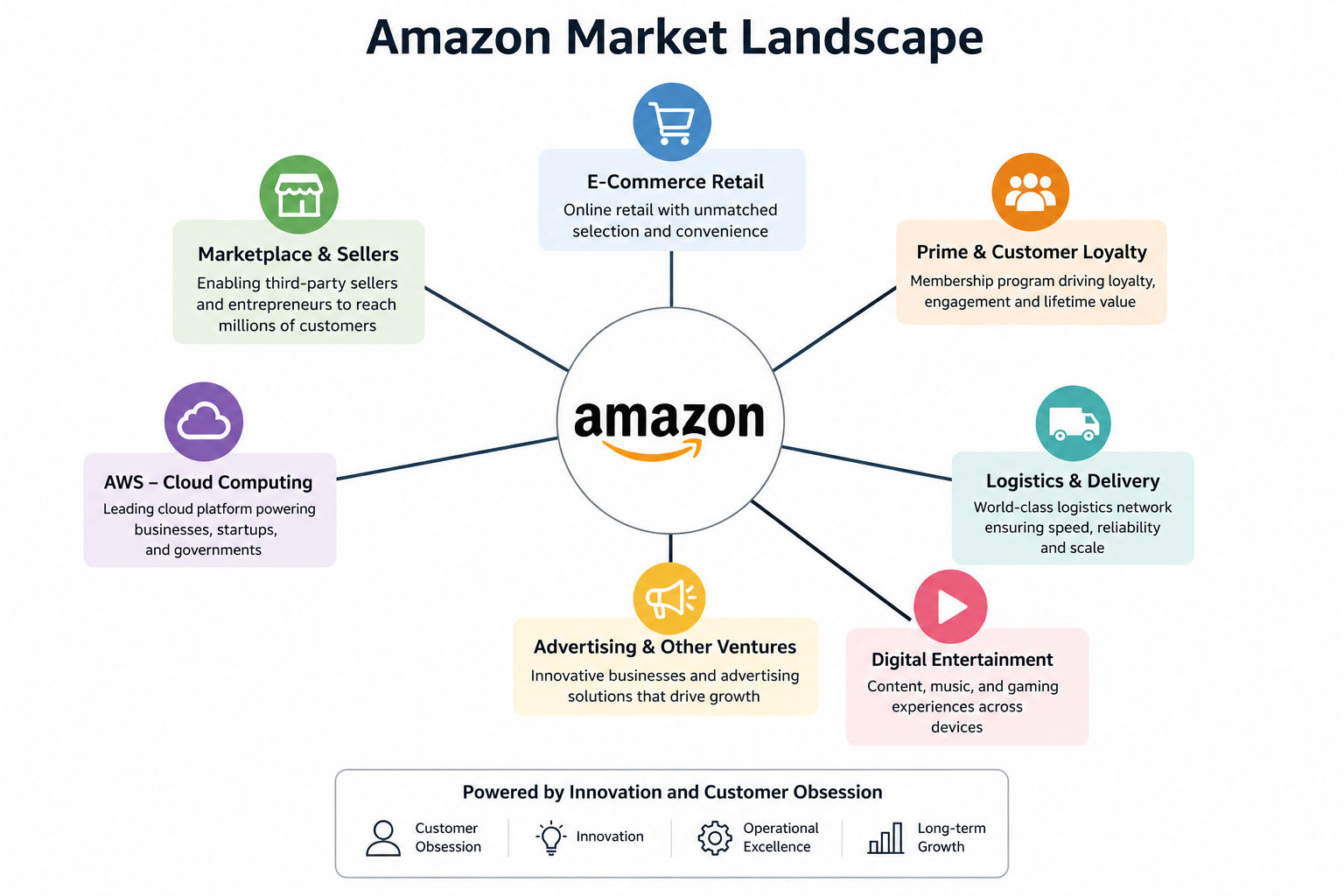
- Marketplace — Amazon’s own products plus millions of third-party sellers’ items, powered by a fulfillment network with 1M+ robots.
- Prime — Shipping, streaming, and grocery perks bundled into one fee; the glue that locks customers into everything else.
- AWS — Rents computing power and AI tools to businesses of any size; Amazon’s most profitable arm.
- Devices — Kindle, Echo, Fire; sold near cost to keep people inside the ecosystem, not to make money on their own.
- Advertising — Sponsored listings and Prime Video ads, powered by real purchase data.
- Entertainment — Prime Video, MGM (Bond), Twitch, Music, Audible; built to make Prime stickier, now profitable in its own right.
- Frontier bets — Amazon Leo, Zoox, healthcare; expensive and unprofitable, affordable only because of the core business.
05
BUSINESS MODEL
A handful of revenue engines fund each other — nicknamed “the flywheel.”
| Segment | What it is | Why it matters |
|---|---|---|
| Online Stores | Products Amazon buys and resells itself | The original business; now smaller and low-profit |
| Third-Party Services | Fees for outside sellers using Amazon’s site and warehouses | Moves most items sold; no inventory risk for Amazon |
| Subscriptions (Prime) | Membership fees | Predictable income that locks in loyalty |
| AWS | Renting computing power and AI tools | Amazon’s most profitable segment by far |
| Advertising | Sponsored listings and streaming ads | Fastest-growing, second-most profitable — bigger than YouTube’s yearly revenue |
Revenue is total sales; profit is what’s left after costs. Retail has thin margins; AWS has a small share of revenue but an outsized share of profit, because cloud computing costs far less to deliver than shipping boxes.
Why it’s hard to copy. AWS exists because Amazon needed serious computing power to run its own site — renting the spare capacity became a profit engine that now subsidizes retail’s thin margins. Walmart has no cloud business to lean on; Microsoft has no shopping data. Amazon is the only company running both extremes under one balance sheet.
Lock-in. Prime’s paid shipping makes buying elsewhere feel wasteful. AWS customers face real switching costs once software is built around Amazon’s tools. Multi-year AI chip contracts (Anthropic, OpenAI) now lock in future cloud revenue the same way.
06
Technology
Build infrastructure in-house at scale, then use it to cut cost and time out of every step from click to delivery.
- Cloud (AWS) — ~30% of the global market, ahead of Azure (low-20s) and Google Cloud (11–13%), built on two decades of operating experience few can match.
- Custom AI chips — Trainium, Graviton, and Inferentia cut reliance on Nvidia. Crossed a $20B annual run rate in 2026, with Anthropic, OpenAI, and Meta signed on.
- Warehouse robotics — 1M+ robots across 300+ centers, coordinated by DeepFleet AI, shifting human labor from lifting to maintenance and oversight.
- AI products — Bedrock lets businesses build on AI models (including Claude); Rufus, Amazon’s shopping assistant, saw usage jump several hundred percent in 2026.
- Satellites (Amazon Leo) — A Starlink competitor with several hundred satellites launched toward a 3,000+ goal, behind schedule and far behind Starlink’s 10,000+.
None of this is impressive as engineering alone — it’s durable because it’s too expensive and slow for most rivals to match.
07
Customers
Retail consumers (~260M Prime members worldwide, 185M in the US) show strong lock-in: US Prime members spend ~$1,170/year vs. ~$570 for non-members.
Third-party sellers, who move most of Amazon’s physical merchandise, depend on Amazon’s search and ranking for visibility — the crux of the FTC’s antitrust case.
Enterprise/government cloud customers stick with AWS for service breadth, security certifications, and migration friction — Amazon’s stickiest base.
AI labs (Anthropic, OpenAI, and startups) are newer and more concentrated. AWS is deliberately diversifying beyond any single big AI customer by also courting banks, healthcare, and traditional enterprise — a hedge Microsoft’s early OpenAI exclusivity didn’t have.
08
Competitors
| Arena | Main competitors | How the fight looks |
|---|---|---|
| U.S. retail | Walmart, Target, Costco | Walmart has closed much of the delivery-speed gap; Costco wins on membership loyalty |
| Global e-commerce | Alibaba, Temu, JD.com, Shopify | Alibaba dominates China; Temu undercuts on price in the U.S. and Europe |
| Cloud | Microsoft Azure, Google Cloud | AWS leads at ~30%; Azure has grown fastest on its OpenAI ties |
| Streaming | Netflix, Disney+, Apple TV+ | Prime Video rides inside a shipping membership rather than selling standalone |
| Advertising | Google, Meta, Walmart Connect | Amazon’s ad business is ~10x its nearest retail-media rival |
Amazon rarely faces one dominant rival — it faces a different specialist in each arena, and responds by using profit from its strongest business to fund the weakest fight.
09
Strengths
- Logistics network — decades of warehouse and robot investment make fulfillment faster and cheaper than rivals can match.
- AWS profit engine — funds thin retail margins competitors can’t match.
- First-party data — knows what people actually buy, not just click; more valuable to advertisers.
- Prime lock-in — paid shipping makes shopping elsewhere feel wasteful.
- Custom chips — insulates Amazon from Nvidia shortages and price hikes.
- Capital scale — ~$200B/year funds bets smaller rivals can’t afford.
10
Weaknesses
- Regulatory/legal exposure — FTC monopoly suit (trial 2027), a $2.5B Prime settlement, a Marketplace pricing class action, and EU “gatekeeper” rules.
- Labor/safety criticism — warehouses show notably higher injury rates than the industry average, fueling unionization Amazon generally resists.
- Thin retail margins — depend on continued AWS and advertising subsidy.
- AWS dependence — a cloud slowdown would hit total profit disproportionately.
- Frontier bet risk — Amazon Leo is behind schedule and behind Starlink; Zoox and others remain unproven.
- Reputational pressure — warehouse conditions and the Prime controversy keep Amazon a recurring political target.
12
Meredean Analysis
Where does the real power come from? Not any single product — but a two-decade-old accident: building serious computing infrastructure to run Amazon’s own store, then discovering it was valuable enough to sell to everyone else. That gave Amazon two businesses with opposite economics — thin-margin logistics and fat-margin infrastructure — under one balance sheet. Almost every strength in this dossier traces back to that.
The reusable principle. A company becomes hard to compete with not by doing one thing better than everyone, but by owning two businesses with opposite economics and letting the profitable one subsidize the unprofitable one on purpose. Cable bundled internet and TV; Apple uses services to subsidize hardware. Amazon’s version is more extreme — retail and cloud are different industries entirely, connected only by the money flowing between them.
What drives management? Jassy’s cost discipline — layoffs, the in-office mandate, Leadership Principles tied to reviews — isn’t nostalgia. It frees cash for the roughly $200B a year AWS now needs to keep pace with Microsoft and AI demand.
What’s hardest to copy? Not the robots or chips — those are buildable. What’s hard to copy is having built it first, at scale: a logistics network refined over 20 years, or a cloud customer base too costly to migrate away from. That’s why thin margins are strategic, not accidental — they make matching Amazon’s scale irrational for the next competitor.
What risks get too little attention? Amazon’s profit is now concentrated in AWS and advertising, not the retail business most people associate with the name — a slowdown in either would expose retail’s underlying thinness. And its regulatory and labor problems — the FTC case, the pricing lawsuit, EU rules, warehouse safety — aren’t separate issues. They’re the same tension: the scale that makes Amazon work is what regulators and workers increasingly want restrained.
How is Amazon reshaping the industry? By becoming a chip supplier, not just a chip buyer. If Trainium succeeds as an external product, it restructures AI infrastructure the same way Amazon once restructured retail.
The takeaway. Scale alone isn’t a moat. Scale plus the deliberate right to lose money in one business to win in another is one of the hardest structures to copy — and it’s the real engine behind the boxes and the arrow logo.
