Most people think power looks obvious.
A glowing logo on a skyline. A charismatic founder on a magazine cover. A trillion-dollar company announcing a new product while cameras flash like lightning around it. We’ve been trained to recognize influence through visibility, almost like civilization itself operates through celebrities and symbols.
But some of the most powerful forces in the economy are actually hidden giants in business operating far away from public attention.
No one lines up overnight to buy their products. Teenagers don’t wear their logos. They rarely appear in documentaries about innovation. And yet entire economies would begin to malfunction without them.
Maybe we’ve been looking at this the wrong way.
Because the companies shaping the modern world are often not the ones demanding attention. They are the ones quietly sitting beneath everything else.
Like foundations under a city.
Invisible until something cracks.
Why Hidden Giants in Business Quietly Control Infrastructure
The internet age created a strange illusion that visibility equals dominance. It made us believe the companies we constantly hear about must also be the companies holding the most structural power. But structural power works differently. It behaves more like infrastructure than fame.
And infrastructure rarely needs applause.
The real question isn’t which companies people admire. It’s which companies the system cannot operate without.
That is a much more unsettling question.
Take semiconductor suppliers. Most people recognize consumer brands—the phones, laptops, gaming systems, AI tools. But behind those products exists a dense industrial web of manufacturers, equipment firms, materials suppliers, and fabrication specialists that almost nobody talks about.
One company produces the machines capable of manufacturing advanced chips at scale. Another controls essential chemicals. Another dominates precision optics. Another handles testing infrastructure. Remove even one layer, and entire technological ecosystems begin to slow down.
Not collapse instantly.
That would almost feel dramatic enough to notice.
Instead, delays ripple outward silently. Factories stall. Innovation timelines stretch. Prices shift. Nations panic behind closed doors.
Modern civilization increasingly behaves like a giant stack of dependencies. And hidden giants in business sit at the deepest layers of that stack.
For deeper insight into industrial dependence and global systems, research from McKinsey & Company and World Economic Forum reveals how fragile modern supply chains have quietly become.

The Structural Power Behind Hidden Giants in Business
What makes these companies fascinating is not merely their wealth. It’s their position.
Most famous companies compete for consumer attention. Hidden giants in business compete for necessity.
There’s a difference.
Attention is emotional. Necessity is structural.
One can disappear within months. The other becomes embedded into the architecture of reality itself.
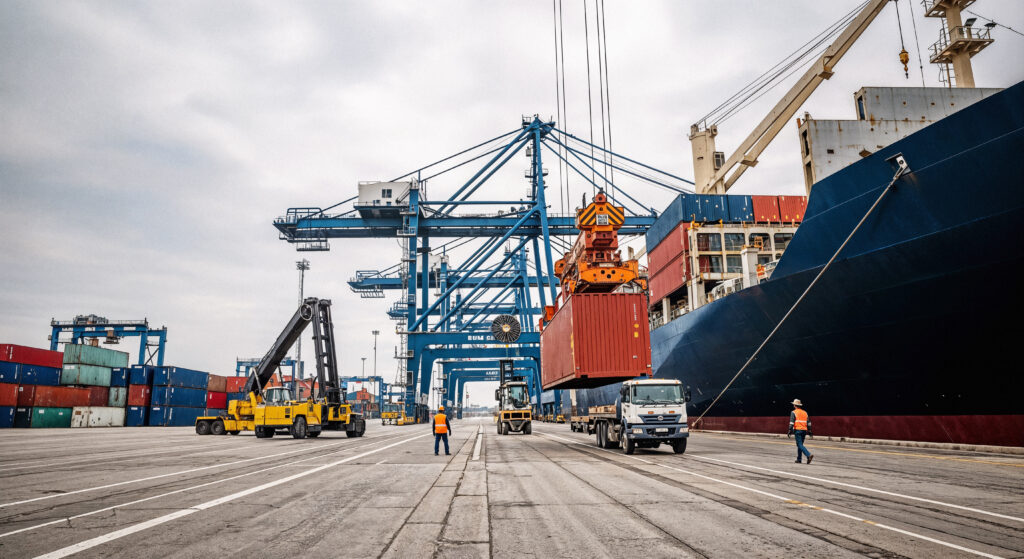
Think about logistics companies. Not the delivery apps people casually use every day, but the vast networks operating beneath global trade: shipping routes, cargo systems, freight coordination, warehouse automation, industrial supply chains.
A delayed container in one port can quietly affect manufacturing on another continent weeks later. A shortage of truck drivers can influence food pricing without consumers ever understanding why. A single logistics bottleneck can alter political conversations, inflation rates, even election outcomes.
Yet most people never think about the systems carrying the physical world around them.
That’s the strange thing about invisible power. It works best when nobody notices it.
Electricity is only discussed during blackouts.
Water systems become interesting during droughts.
Infrastructure attracts attention mainly through failure.
And maybe corporations function the same way.
How Hidden Giants in Business Shape the Modern Economy
We tend to imagine business as persuasion—advertising, branding, storytelling, hype. But at the highest level, business becomes something colder and more permanent. It becomes systems management.
The companies with the deepest influence are often the ones reducing friction for other companies. They don’t dominate culture directly. They dominate dependency chains.
Which is why B2B software firms have quietly become some of the most important entities in the global economy.
Most people have never heard of the platforms managing payroll systems, cloud security layers, industrial databases, enterprise logistics, or digital identity verification. Yet governments, banks, hospitals, airlines, retailers, and manufacturers depend on them constantly.
A consumer app disappearing might irritate people.
An enterprise infrastructure platform failing can freeze institutions.
That distinction matters.
Because it reveals something uncomfortable about modern power: visibility is often inversely proportional to structural importance.
The companies most essential to daily life are frequently the least culturally visible.
Maybe this assumption doesn’t actually hold—that fame naturally rises to the top.
Maybe modern systems deliberately hide their deepest layers because complexity itself becomes invisible at scale.

The Future Belongs to Hidden Giants in Business
A city resident rarely thinks about sewage systems. Not because they’re unimportant, but because functioning infrastructure disappears psychologically. Human attention drifts toward surfaces.
The same thing happens economically.
We notice products. We ignore frameworks.
But frameworks decide what products can exist in the first place.
This changes how you see dominance.
A social media company may control attention. But the cloud infrastructure provider hosting half the internet controls continuity. A flashy electric vehicle brand may dominate headlines, but the mineral processing firms behind battery production quietly shape the future of transportation.
Civilization increasingly resembles a pyramid of hidden dependencies. At the top sit visible consumer experiences. Beneath them exist invisible industrial layers most people never examine.
And those layers are consolidating.
That may be the most important part of all.
Because hidden giants in business often operate inside markets where competition becomes nearly impossible.
The barriers are too high.
The expertise too specialized.
The infrastructure too expensive.
The relationships too entrenched.
And necessity compounds.
Why Hidden Giants in Business Matter More Than Famous Brands
Over time, these companies gain something more valuable than popularity: embeddedness.
They become stitched into the operational fabric of economies.
Governments depend on them.
Supply chains orbit around them.
Entire industries evolve according to their capabilities and limitations.
This is where hidden giants in business stop feeling like corporations and start feeling like geological forces.
Slow-moving. Massive. Structural.
The strange part is that society still struggles to emotionally process this type of power because humans evolved to notice visible authority—kings, celebrities, political leaders, public figures.
Hidden systemic power feels abstract, even when it shapes everyday life more directly.
Maybe the problem isn’t the economy—but how we’re trying to perceive it.
We still think in terms of personalities while the world increasingly operates through systems.
And systems don’t need charisma.
They need control points.
Research from Harvard Business Review increasingly points toward infrastructure dominance becoming more strategically valuable than consumer visibility itself.

The Invisible Architecture Behind Modern Civilization
That may explain why some of the most valuable strategic battles happening today revolve around infrastructure layers most consumers barely understand.
Semiconductor manufacturing.
Data centers.
Shipping lanes.
Rare earth processing.
Industrial AI tooling.
Cloud computing architecture.
These are not merely industries.
They are leverage points.
Control the visible product, and you influence consumers.
Control the hidden layer beneath many products, and you influence entire sectors simultaneously.
That is a different magnitude of power entirely.
And perhaps the strangest part is this:
The future may not belong to the loudest companies.
It may belong to the hidden giants in business positioned so deeply inside global systems that removing them becomes nearly impossible.
Not brands people love.
Frameworks people unconsciously depend on.
Which means the real architecture of modern power may not exist on magazine covers or trending pages at all.
It may exist in server rooms, shipping routes, industrial software dashboards, semiconductor fabs, and supply chain maps nobody ever sees.
Invisible.
Until the world pauses long enough to notice what was carrying it the entire time.