


How the Cannes Film Festival Turned Prestige Into Economic Power
The world’s most glamorous film festival built its influence by making access its scarcest product.

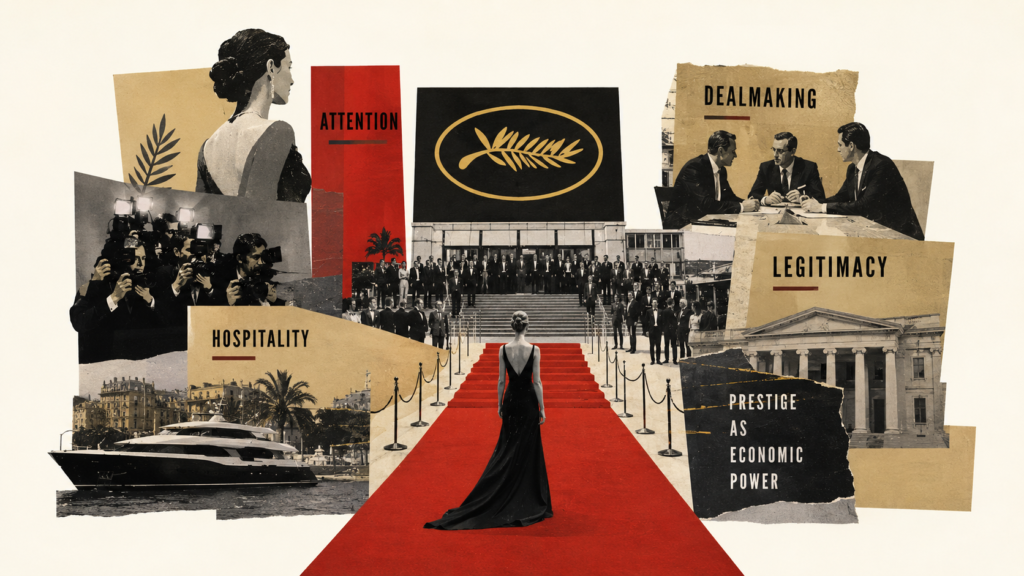
Image Credits: Exclusively Meredean Illustration
WHY THIS STORY MATTERS
Most discussions about luxury focus on products.This essay explores the systems that shape taste long before consumers make a purchase.
Cannes Doesn’t Sell Movies. It Sells Scarcity.
How the Cannes Film Festival Turned Prestige Into Economic Power
The Cannes Film Festival isn’t one of the world’s most valuable cultural institutions because it celebrates cinema. It’s valuable because it controls access to prestige. Founded in the shadow of World War II as an alternative to the politically influenced Venice Film Festival, Cannes was built on the idea that cinema needed an independent stage. Nearly eight decades later, that stage has become one of the world’s most effective machines for turning prestige into economic power.
Most people know Cannes for one thing: the red carpet. Sixty meters of it, replaced every single day of the festival so it photographs perfectly against the gowns. The old carpet isn’t thrown away — it’s trucked to Marseille and resold as flooring for a few cents per square meter. Even the leftovers of Cannes have a business model.
But the carpet isn’t the story. It’s the surface of something else: an institution that manufactures scarcity, then sells that scarcity in at least four separate markets, at the same time, to buyers who barely interact with each other.
The product is access, not art
Only about twenty films compete for the Palme d’Or each year, chosen from thousands of submissions. That selectivity is the entire mechanism. If Cannes let everyone in, none of what follows would work.
The hospitality market sells proximity. For ten days, the Riviera becomes one of the most expensive patches of coastline on earth. Hotel and restaurant prices near the Croisette can triple, and some hotels reportedly earn around a fifth of their annual revenue during festival week alone. Yachts, private security, and concierge firms all plug into the same short window. None of that spending is about watching movies. It’s about renting proximity to the event.
The attention market sells visibility. Brands don’t just sponsor Cannes — they measure it like a stock. Analytics firm Launchmetrics put the 2025 festival’s global media value at roughly $1.1 billion, spread across regions from France to India to Brazil. Chopard, a watch and jewelry house with no film to sell, ranked as the single highest-value brand of the festival on the strength of celebrity styling alone. The thing being purchased here isn’t a ticket. It’s borrowed prestige, priced down to the individual red-carpet photograph.
The dealmaking market sells opportunity. Behind the galas sits the Marché du Film, the festival’s film market, where somewhere between 12,000 and 16,000 industry professionals negotiate distribution rights each year. Industry estimates put its yearly turnover between $600 million and $1 billion. In 2026 alone, reported sales included a Park Chan-wook thriller that a new Warner Bros. label acquired for around $30 million, and a psychological drama that Amazon MGM Studios picked up for just over $20 million — deals often signed before the film has even screened publicly, priced almost entirely on how the market reads the festival’s buzz.
The legitimacy market sells credibility. The newest and most consequential layer involves governments, not companies. Sovereign-backed funds tied to Saudi Arabia’s Vision 2030 program have reportedly committed billions of dollars to film financing, alongside production rebates worth as much as 40 to 50 percent under regional incentive schemes. That money isn’t only chasing box-office returns. It buys a seat inside an institution the rest of the world already treats as culturally credible — a shortcut to legitimacy that would otherwise take decades to build.
Each market looks different, yet every one depends on the same underlying asset: controlled access. Four markets. One shared asset: Cannes’ ability to decide who and what matters.
Why the gate has to stay narrow
This is where the tension shows up. Every one of those four markets depends on Cannes staying selective. The moment access becomes easy, the value collapses everywhere at once — the hotels, the brands, the deal prices, and the state investment all lose their reason for showing up.
That threat came from Netflix. Built around simultaneous global streaming releases, the company refused to comply with Cannes’ theatrical requirements and has stayed outside the main competition ever since. The disagreement wasn’t simply about distribution. It reflected a deeper conflict between an institution built on selective access and a platform built on universal availability.
The same pressure shows lower in the market too. Bidding for festival-selected titles has grown so competitive that top packages now command seven-figure guarantees before a single public screening, while mid-tier films — once the safer bet for buyers — have become the most volatile part of the market, with distributors walking away when the numbers stop lining up. Scarcity rewards those with the capital to move first.
The irony underneath it all
Here’s the part worth sitting with. Cannes was built to keep cinema out of the hands of a state that had turned a film festival into propaganda. Today, government-linked capital is one of the biggest forces shaping who gets financed and shown there — just routed through investment funds and tax rebates instead of political censorship.
That’s not necessarily corruption. It’s a pattern that shows up anywhere an institution controls a scarce, trusted signal: universities, ratings agencies, award bodies, even central banks. Once an institution’s approval becomes valuable enough, the money finds a way to buy proximity to that approval, whether or not it was ever the intended audience.
Cannes’ real innovation was never discovering great films. It was discovering that prestige, rationed carefully enough, behaves like a currency — one that hotels can charge against, brands can measure, studios can price into deals, and governments can use to purchase legitimacy they couldn’t otherwise afford.
The open question is what happens if that currency gets diluted. Prestige only holds its value while it looks earned rather than bought. As more of Cannes’ financing, hotel spend, and marketing budgets get engineered by the very capital chasing its validation, it gets harder to tell which came first — the film that deserved the red carpet, or the money that decided it should.
Cannes is ultimately a case study in a broader economic principle: when access to a trusted institution is limited, prestige itself becomes a tradable asset. The festival doesn’t merely reward great films. It determines which stories, brands, and people receive one of the world’s scarcest forms of value: cultural legitimacy.
Recommended Reading
- Why Big Tech Insider Threats Can’t Easily Break Systems From the Inside
- The Creator Economy Has Moved Beyond Hollywood.
- GTA 6 Isn’t Building a Game. It’s Building a Digital City.
- How Dior Became the Wedding Brand for the World’s Most Influential Women
- Nikhil Kamath’s BTG Reveals a Different Way to Build Creative Businesses.
Receive Infrastructure of Thought
One thoughtful essay every week. No noise. No algorithms.
Just ideas worth your time.
By subscribing, you agree to our Terms of Use and Privacy Policy.
