


Why Countries Fight Over Rivers—and Why the Water Is Only Part of the Story
Ethiopia says the Grand Ethiopian Renaissance Dam is designed to generate electricity rather than permanently consume Nile water. Egypt has nevertheless spent more than a decade treating the project as an existential challenge.
That gap helps explain many of the world’s most consequential river disputes.

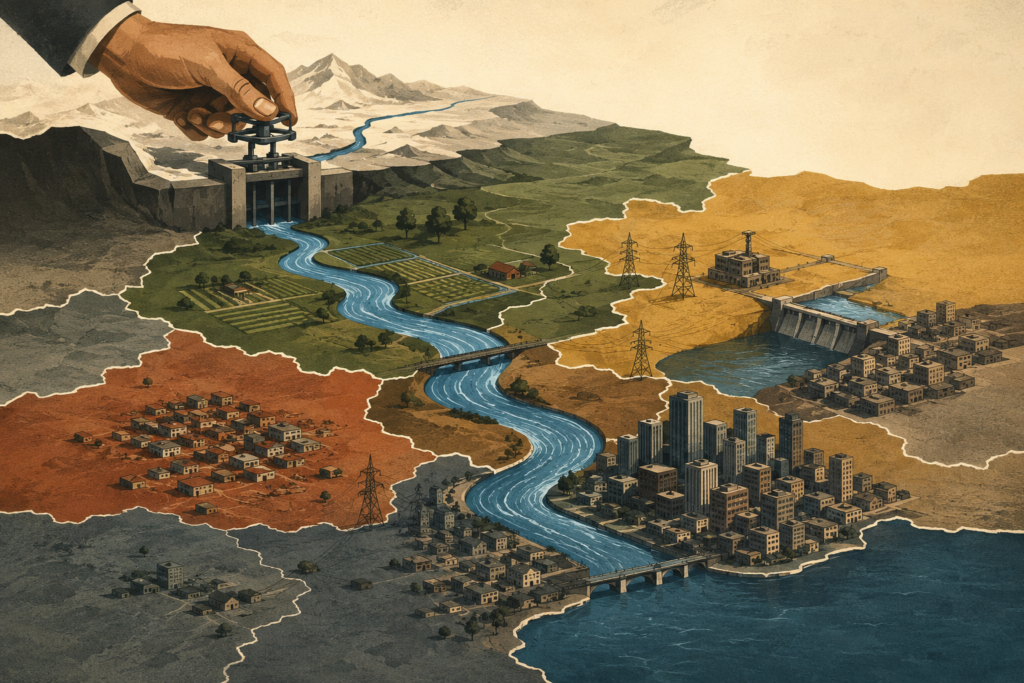
Image Credits: Illustration Exclusively by Meredean
WHY THIS STORY MATTERS
The world’s most important river disputes are rarely just about water. They are about how geography, infrastructure, and political power combine to give some countries greater influence over the lives and economies of others.
For decades, analysts have promised a coming age of water wars: nations locked in open combat over dwindling rivers. It hasn’t happened, at least not in the way anyone predicted. What has happened instead is quieter and stranger. Countries are not fighting over water running out. They are fighting over who gets to decide when it arrives.
That distinction is the whole system. Start with geography, not scarcity
Every major transboundary river creates the same structural problem, regardless of politics, religion, or wealth. One country sits upstream. Everyone else sits downstream. The upstream country controls the flow. The downstream country controls nothing except its dependence.
International law tries to soften this. Treaties speak of “equitable use” and an obligation not to cause “significant harm.” But a treaty is an agreement between governments. A river doesn’t sign anything. It simply does what the upstream dam operator tells it to do. Law is a restraint people agreed to respect. Geography is a fact they cannot renegotiate.
This is why river disputes rarely resemble ordinary resource conflicts, like a fight over oil or farmland. Oil can be bought elsewhere. A river cannot be rerouted around a hostile neighbor. Downstream nations are permanently exposed to a decision-maker they didn’t elect, can’t remove, and increasingly don’t trust.
The Nile: development framed as an existential threat
Ethiopia calls the Grand Ethiopian Renaissance Dam a triumph of self-reliance — a roughly $5 billion hydropower project built to expand electricity generation in a country where millions still lack reliable power. Addis Ababa insists the dam is non-consumptive: it generates electricity without permanently removing water from the system.
Egypt does not see it that way. Egypt depends on the Nile for the overwhelming majority of its freshwater. What’s notable is what Egypt has not done. It has ruled out military strikes. Instead, it has spent years quietly repositioning across the Horn of Africa — securing port access in Djibouti, Eritrea, and Somalia — building leverage on the map rather than on the river itself, while a Trump-brokered mediation effort between Cairo and Addis Ababa has stalled amid other regional priorities. Favorable rainfall in recent years has helped reduce immediate pressure on the system. That has eased tensions, but it has not resolved the underlying disagreement over how the river should be managed during future droughts.
The Indus: a treaty put in abeyance
In April 2025, a day after gunmen killed 26 people in Pahalgam, Kashmir, India suspended its participation in the 1960 Indus Waters Treaty — one of the most durable water-sharing agreements in the world, one that had survived three wars between India and Pakistan. India tied the suspension explicitly to Pakistan’s alleged support for militant groups, framing it as a matter of national security rather than hydrology.
More than a year later, the treaty remains in abeyance. Pakistan’s arbitration efforts at The Hague have produced rulings India simply rejects as illegitimate. Pakistan’s own defense minister has said publicly that water scarcity is now a matter his country would consider going to war over — while adding that current conditions don’t yet warrant it. More than a year later, the treaty remains in abeyance. Pakistan’s arbitration efforts at The Hague have produced rulings India rejects, while both governments increasingly frame the river through the language of national security rather than cooperation. The suspension has shifted attention away from legal agreements and toward the physical infrastructure that governs the river itself. Even without military escalation, water has become part of a broader strategy of political pressure.
The Mekong: leverage without even a seat at the table
China operates eleven mega-dams on the upper Mekong, which it calls the Lancang, and it is not a member of the Mekong River Commission that governs the river downstream. A growing body of research has argued that: China’s dams hold back water during the wet season and release it during the dry season to suit hydropower schedules, flattening the natural rhythm the river’s ecosystems and farmers depend on. Researchers have argued that altered river flows from upstream dams, combined with changing rainfall patterns, have intensified water stress across parts of the lower Mekong basin during recent droughts.
No treaty was broken here, because there was barely a treaty to begin with. That is its own kind of lesson.
Upstream is not a location. It’s a form of power that borders cannot reach.
Why the same pattern keeps repeating
Three rivers, three regions, three completely different political relationships — and the same structure underneath all of them. An upstream state builds infrastructure. A downstream state discovers that its water security now runs through someone else’s decision-making. Law gets invoked, arbitration gets requested, and none of it changes who ultimately controls the flow.
This is the tension that never resolves cleanly: sovereignty says a nation controls what happens inside its own borders, and a dam is, legally, entirely inside the upstream nation’s borders. But a river’s water doesn’t recognize where one country’s territory ends. Two legitimate principles — the right to develop your own land, and the right to depend on a river that predates your country — collide, and there is no neutral referee with the power to enforce a verdict.
That is precisely why these disputes rarely become declared wars. War is loud, attributable, and expensive. Changing the timing or flow of a river can be quieter, harder to attribute, and politically less costly than open confrontation. A government can point to drought, maintenance, or engineering necessity. Meanwhile the downstream population still doesn’t get the water. Coercion without a shot fired is, for most governments, simply the better trade.
The part that outlasts any one river
None of this is really about hydrology. It is about what happens whenever one party controls a chokepoint in a flow that another party depends on and cannot reroute. Rivers are simply the oldest version of that problem. The same asymmetry shows up in energy pipelines that cross borders, in undersea cables that carry a region’s entire internet traffic, in the handful of factories that make the chips modern economies run on. Whoever sits upstream—in water, energy, or data—inherits a form of leverage that treaties, contracts, and diplomacy can limit but rarely eliminate.
Climate change is only sharpening this. Rainfall is becoming less predictable, dry seasons longer, and populations along these rivers larger. Every one of those pressures increases the strategic value of controlling the flow, giving upstream governments more reason—not less—to hold on to that leverage rather than trade it away.
Whether Cairo and Addis Ababa, or New Delhi and Islamabad, eventually turn their standoffs into open conflict is genuinely uncertain — history suggests these disputes usually settle into long, tense equilibrium rather than war. What is not uncertain is the shape of the leverage itself. A treaty can bind governments. It cannot change the direction a river flows. That is the story worth remembering the next time a headline calls it a “water dispute,” because the real contest has often been over who controls the flow—not simply who needs the water.
Recommended Reading
- Why Big Tech Insider Threats Can’t Easily Break Systems From the Inside
- The Creator Economy Has Moved Beyond Hollywood.
- GTA 6 Isn’t Building a Game. It’s Building a Digital City.
- How Dior Became the Wedding Brand for the World’s Most Influential Women
- Nikhil Kamath’s BTG Reveals a Different Way to Build Creative Businesses.
Receive Infrastructure of Thought
One thoughtful essay every week. No noise. No algorithms.
Just ideas worth your time.
By subscribing, you agree to our Terms of Use and Privacy Policy.
