


Why Singapore Became Asia's Wealth Management Capital
Eighty-eight percent of the money managed in Singapore is invested somewhere else. The country that built Asia’s largest wealth industry does not actually want to hold your wealth.

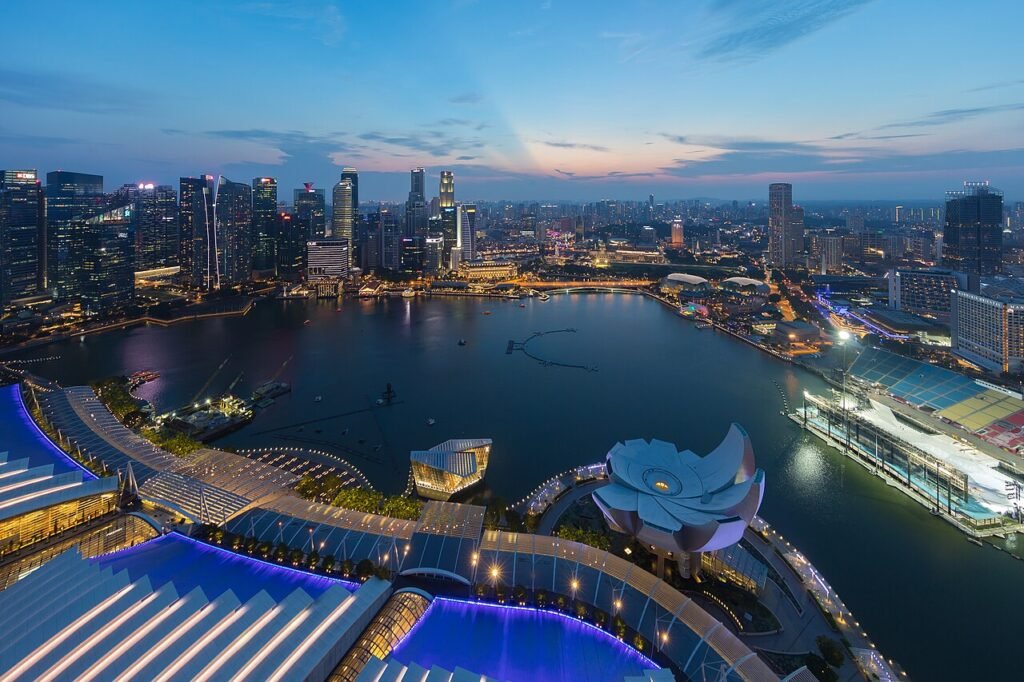
Basile Morin, via Wikimedia Commons, licensed under [CC BY-SA 4.0]
That fact sits strangely next to everything people think they know about the place. For a decade, the story of Singapore has been told the same way: low taxes, high safety, a friendly government, and a wave of billionaires — Ray Dalio, Sergey Brin, Chinese entrepreneurs fleeing Beijing’s crackdowns and a collapsing property market — quietly moving their fortunes into the city-state’s gleaming towers. Family offices went from a few hundred to well over a thousand in under five years. The label stuck: Singapore, the new Switzerland of Asia, a vault for a nervous global elite.
The vault image is comforting and it is wrong. A vault holds things. Singapore’s system is built to move things through. Nearly nine in ten dollars managed there get deployed into markets elsewhere — the United States, Europe, the rest of Asia. The country isn’t hoarding capital. It is routing it, and the fee it charges for that routing, collected through fund managers, private bankers, lawyers, and administrators, is what actually built the industry. By 2025, total assets under management in Singapore reached roughly S$6.7 trillion, up from S$5.4 trillion just two years earlier. That growth wasn’t wealthy families burying money in a safe. It was capital passing through a jurisdiction it had come to trust, on its way somewhere else.
This distinction — vault versus router — is the whole story, and almost nobody tells it that way.
To see why the distinction matters, it helps to look at how the system was actually built. The Monetary Authority of Singapore did not simply cut taxes and wait. It engineered a ladder. An entry-level scheme lets a family with tens of millions in qualifying assets set up a single-family office and pay no tax on investment income, provided they hire local staff and spend a set amount in the local economy each year. A step up requires roughly five times that in assets and buys a longer exemption. A top tier, reserved for families with hundreds of millions, demands that at least one family member actually live and work in Singapore. Layered on top is the Global Investor Programme, which trades permanent residency for a large domestic investment, and a fund structure called the Variable Capital Company, which lets one legal shell hold many separate portfolios for many branches of a family without cross-liability.
None of this reads like a tax break. It reads like a filter. Each tier is a test of seriousness — how much capital, how much local commitment, how much willingness to be transparent with a regulator that keeps raising the bar. Singapore was not competing to be the cheapest place to park money. It was competing to be the most credible.
Credibility, it turns out, is a scarcer resource than low tax rates. Any jurisdiction can cut a corporate rate. Very few can convince a family that has just watched its home government freeze bank accounts, tighten capital controls, or rewrite the rules mid-game that the new jurisdiction won’t do the same thing in five years. Singapore’s advantage was never really fiscal. It was an independent judiciary built on English common law, a currency managed against a trade-weighted band rather than pegged to political convenience, and a government that has not changed its ruling party in six decades. In a region where Hong Kong was absorbing mass protests, a sweeping national security law, and years of pandemic border closures, and where mainland China was tightening capital outflow controls on its own wealthy citizens, Singapore’s pitch was almost boringly simple: nothing dramatic will happen here.
Money does not move first for the lowest tax rate. It moves for the highest confidence that today’s rules will still be true in ten years.
That sentence is the mechanism, and it explains far more than Singapore’s rise. It explains why global capital has historically clustered in a small number of small, stable, legally boring places — Zurich, Luxembourg, Delaware — rather than spreading evenly across every jurisdiction offering a good deal. Trust is not divisible. A country either has a long, unbroken record of honoring contracts and property rights, or it is asking to be trusted for the first time, and capital treats those two situations completely differently.
But a system built to move capital frictionlessly across borders has a structural weakness: the friction that keeps out dirty money is the same friction that keeps out clean money. You cannot make the door easier for the family fleeing an unstable currency without also making it easier for the syndicate laundering the proceeds of an online gambling ring. In August 2023, Singapore found this out in the most public way possible. Police raided homes across the island and arrested ten foreign nationals in what became one of the largest money-laundering cases in the country’s history. Seized and frozen assets eventually topped S$3 billion — mansions, supercars, gold bars, luxury handbags. Six single-family offices that had received tax incentives turned out to be linked to people caught up in the case. Regulators fined nine financial institutions for compliance failures.
The scandal did not sink Singapore’s reputation, but it forced a choice, and the choice reveals the system’s real tension. Singapore tightened the door: assets under management would now be measured only against genuine investment holdings rather than total wealth, minimum thresholds rose, and requirements for locally based investment staff got stricter. Each of those changes filtered out more bad actors — and, inevitably, more borderline-legitimate money that simply couldn’t clear the new bar.
Hong Kong did the opposite at almost the same moment. Facing years of capital flight to Singapore, it launched a rival family-office regime with no minimum asset requirement at all. The effect showed up quickly in the numbers: by some industry trackers, Hong Kong’s single-family-office count grew faster than Singapore’s through 2025, pulling ahead in raw headcount by chasing mainland Chinese wealth that Singapore’s newly narrowed door was no longer built to admit.
Read one way, that looks like Singapore losing. Read correctly, it looks like Singapore choosing. A jurisdiction that has staked its entire value proposition on being the credible option cannot also be the option with the lowest bar to entry — the two positions cancel each other out. Hong Kong, still working to rebuild trust after 2019 and still operating under Beijing’s tightening oversight, is competing on volume because it currently can’t compete on the same certainty Singapore sells. Singapore, having built a decade of institutional credibility, is defending that credibility even when it costs headcount. They are not running the same race.
This is the pattern worth carrying into other domains, because it rarely stays confined to wealth management. Any institution whose core product is trust — a bank, a certification body, a ratings agency, even a marketplace with a review system — eventually faces the same fork. It can widen the entry criteria and win more volume, or it can narrow them and protect the credibility that made the volume valuable in the first place. Institutions that try to do both at once usually end up trusted by no one and chosen by everyone, which is a slower way of losing the same argument.
Zoom out further and Singapore’s real position becomes clearer. As global finance splits along an increasingly hard line between US-aligned and China-aligned systems, a growing share of the world’s capital no longer fully trusts its home jurisdiction — not because of tax rates, but because of sanctions risk, currency instability, and abrupt policy reversals. That capital needs somewhere politically neutral enough to sit between blocs without being claimed by either. Very few places can occupy that role: a country has to be small enough to threaten no one and stable enough to be trusted by everyone, a combination almost no large economy can offer and almost no unstable one can fake. Switzerland held that position for European capital for a century. Singapore has spent twenty-five years quietly building the same position for a world where far more capital, from far more places, now needs somewhere to stand.
The family-office count was never the real scoreboard. The real scoreboard is which jurisdiction global capital trusts enough to pass through, and Singapore built its entire industry on the bet that being trusted matters more than being big.
Recommended Reading
- Why Big Tech Insider Threats Can’t Easily Break Systems From the Inside
- The Creator Economy Has Moved Beyond Hollywood.
- GTA 6 Isn’t Building a Game. It’s Building a Digital City.
- How Dior Became the Wedding Brand for the World’s Most Influential Women
- Why Countries Fight Over Rivers—and Why the Water Is Only Part of the Story
Receive Infrastructure of Thought
One thoughtful essay every week. No noise. No algorithms.
Just ideas worth your time.
By subscribing, you agree to our Terms of Use and Privacy Policy.
